
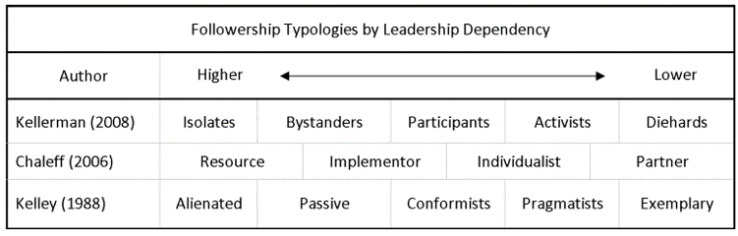
When we begin with the premise that followership represents the attitude of someone fulfilling a follower role, we are challenged to determine how followership relates, or is connected, to leadership. Understanding how followership attitudes are developed will provide insight into why followers respond the way they do in follower roles. Table 1 provides examples of four prominent definitions and illustrate the different research approaches that support the followership typologies provided in Figure 1.
| Table 1 Followership Definitions |
| Crossman and Crossman –
“Followership is a relational role in which followers have the ability to influence leaders and contribute to the improvement and attainment of group and organizational objectives. It is primarily a hierarchically upwards influence.” (2011 p. 484) |
| Chaleff –“Courageous followership is built on the platform of courageous relationship. The courage to be right, the courage to be wrong, the courage to be different from each other. Each of us sees the world through our own eyes and experiences. Our interpretation of the world thus differs. In relationships, we struggle to maintain the validity of our own interpretation while learning to respect the validity of other interpretations.” (2009, p. 4) |
| Kelley –
“People who are effective in the follower role have the vision to see both the forest and the trees, the social capacity to work well with others, the strength of character to flourish without heroic status, the moral and psychological balance to pursue personal and corporate goals at no cost to others, and, above all, the desire to participate in a team effort for the accomplishment of some greater common purpose.” (1988, p. 146–47) |
| Kellerman –
“The response of those in subordinate positions (followers) to those in superior ones (leaders). Followership implies a relationship (rank) between subordinates and superiors, and a response (behavior) of the former to the latter” (2008, p. xx) |
FOLLOWERSHIP TYPOLOGIES
Figure 1 represents followership typologies that are supported by the definitions provided in Table 1. It provides the scholar’s name on the left and then labels their identified typologies according to leadership dependency. Higher leadership dependency reflects lower initiative, lower organizational loyalty, and is generally responsive to specific direction. The far right reflects attitudes more representative of followers who are more like partners with the leaders, are situationally aware, seek opportunities to contribute, and are highly committed to the organizational or task objectives.
home research about contact get started
 followership